

Civic Space | Human Rights | Justice Reform
“The Arrest Is the Punishment” — OSJRP at Civil Society Week for West Africa 2026
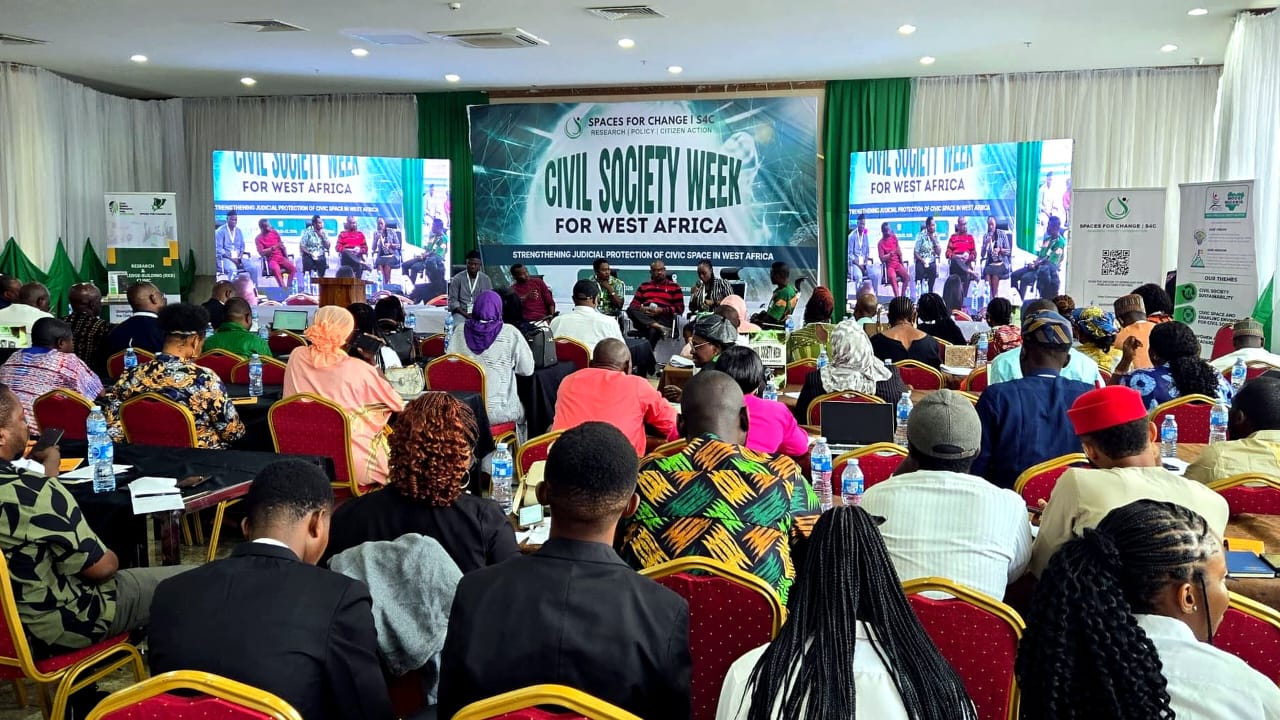
The Executive Director of the Open Society on Justice Reform Project (OSJRP), Samuel Akpologun, joined an Action Group panel in Enugu to examine how security legislation can deter civic participation and why a discharge months after a public arrest may do little to repair the damage already done.
Event: 4th Civil Society Week for West Africa 2026
Location: Enugu, Nigeria
Dates: 22–23 October 2026
Strengthening Judicial Protection of Civic Space in West Africa
The Open Society on Justice Reform Project (OSJRP) participated in the 4th Civil Society Week for West Africa, held in Enugu on 22 and 23 October 2026 under the theme “Strengthening Judicial Protection of Civic Space in West Africa.”
The convening was hosted by Spaces for Change, in collaboration with the West Africa Civil Society Institute and the South Saharan Social Development Organization, with support from the Ford Foundation through the Civic Space Resource Hub.
The gathering brought together civil society actors and advocates to examine the protection of civic freedoms, the role of the judiciary, and the legal and institutional challenges confronting democratic participation across West Africa.
Enugu was a deliberate choice of venue. By taking the conversation beyond Lagos and Abuja, the convening brought attention to a region where insecurity, economic hardship, and long-running agitation make the protection of civic freedoms an immediate concern rather than an abstract constitutional debate.
The event also took place in the same week as the sixth anniversary of the Lekki toll gate shootings of 20 October 2020, a painful reminder of the continuing importance of accountability, the right to peaceful protest, and the protection of citizens who express dissent.
OSJRP Raises Concerns About Judicial Protection of Civil Liberties
Samuel Akpologun, Executive Director of OSJRP, joined the Action Group panel examining the judiciary’s role in protecting freedom of expression, freedom of association, and the right to protest.
When asked whether Nigerian courts are adequately balancing national security considerations against civil liberties, his response was a cautious no.
His concern centred on a pattern frequently encountered in criminal defence practice: once the state characterises a matter as one involving national security, that assertion may be treated as conclusive rather than as a claim that must be supported by evidence and subjected to judicial scrutiny.
This approach raises serious questions about the proper relationship between security institutions, the courts, and the constitutional rights of citizens. National security is a legitimate concern of government, but its invocation should not automatically displace the need for evidence, procedural fairness, and independent judicial assessment.
Where security allegations receive insufficient scrutiny, the practical burden can shift unfairly to the individual, who may find themselves having to justify their liberty rather than being protected by the presumption of innocence and the applicable safeguards of criminal procedure.
“The arrest is the punishment.”The central concern is that public arrest and prolonged prosecution can inflict lasting reputational and psychological harm, even when the case eventually ends in a discharge.
Section 24 of the Cybercrimes Act: Reform and Continuing Concerns
A key issue raised by Akpologun was section 24 of the Cybercrimes (Prohibition, Prevention, etc.) Act, which concerns certain cyber-related offences and has been the subject of sustained public interest and legal scrutiny.
The provision was amended in 2024 following sustained advocacy and a ruling of the ECOWAS Court of Justice. However, concerns remain that the amended language retains a degree of breadth that could leave substantial discretion in the hands of enforcement authorities.
According to the concerns highlighted during the panel, prosecutions have continued despite the amendment. This raises a broader question: how effectively can legislative reform protect freedom of expression if the wording of an offence or the manner in which it is enforced continues to create uncertainty for citizens, journalists, activists, and other public-interest voices?
Laws addressing cybercrime must serve legitimate purposes, including the prevention of genuine criminal conduct. At the same time, their drafting and enforcement should be sufficiently clear and proportionate to prevent lawful expression and public criticism from being unnecessarily chilled.
OSJRP’s current engagement on reform of section 24 reflects its concern that legal frameworks must protect the public without undermining the democratic freedoms that the rule of law exists to secure.
When the Process Becomes the Punishment
The most striking argument presented by Akpologun concerned the difference between the formal outcome of a criminal case and the consequences of the process itself.
Consider a citizen who is arrested publicly, with the event recorded and circulated through news outlets or social media. The arrest may damage the individual’s reputation, disrupt their livelihood, strain family relationships, and create the impression of wrongdoing before a court has determined the case.
Months later, the individual may be discharged, perhaps after the charges are withdrawn or the prosecution fails to establish a sustainable case. Yet the outcome may receive little public attention compared with the original arrest.
The arrest remains visible. The eventual discharge may not.
This imbalance can leave the individual bearing the consequences of an allegation long after the legal proceedings have ended. It can also send a message to others who might otherwise participate in peaceful protests, organise civic campaigns, criticise public officials, or advocate for reform.
The resulting deterrent effect may extend far beyond the person prosecuted. Others may choose silence over participation because they fear arrest, public humiliation, financial loss, or prolonged legal uncertainty.
The concern, therefore, is not limited to whether a conviction is eventually secured. It is whether the arrest and prosecution process itself can become a mechanism of intimidation. Where that occurs, the practical consequences for civic participation may arise long before a court delivers its decision.
Lessons From Protest-Related Litigation and Detention
Other members of the Action Group panel outlined the coalition’s litigation work over the preceding year. This included representing protesters detained following the #EndBadGovernance protests and pursuing the withdrawal of charges considered factually unsustainable.
These experiences illustrate the importance of access to effective legal representation, prompt judicial review, and meaningful remedies where criminal proceedings are not adequately supported by evidence.
Contributions to the discussion also addressed human rights education in secondary schools, regional monitoring of security-related violations, and administrative failures that contribute to unlawful or unnecessarily prolonged detention.
Court registries and other justice-sector institutions are important to the effective administration of justice. Delays in processing documents, communicating court decisions, or implementing lawful orders can have serious consequences for people whose liberty is at stake.
The protection of civic space therefore requires more than sound constitutional provisions. It also depends on functioning institutions, informed citizens, accountable law enforcement, and judicial processes that operate promptly and fairly.
Why Judicial Independence and Accountability Matter
Courts play a critical role in ensuring that public authorities remain within the limits of their lawful powers. Where government action affects freedom of expression, association, peaceful assembly, or personal liberty, independent judicial scrutiny is essential.
This does not mean that national security concerns should be disregarded. Rather, it means that security claims should be assessed according to the law, supported by relevant evidence, and balanced against the rights and freedoms protected by the Constitution and applicable human rights instruments.
Judicial protection must also be practical. A remedy delivered only after a person has spent months in detention, suffered substantial reputational damage, or lost their livelihood may not fully address the harm suffered.
Effective justice requires timely hearings, proper scrutiny of allegations, access to legal assistance, compliance with court orders, and accountability where legal safeguards are disregarded.
OSJRP’s Continuing Commitment to Justice Reform
The issues discussed at Civil Society Week for West Africa are directly connected to the work of the Open Society on Justice Reform Project. Through its engagement with justice reform, civic freedoms, and legal accountability, OSJRP continues to advocate for institutions and processes that protect rights while ensuring that public power is exercised lawfully.
Its current engagement on reform of section 24 of the Cybercrimes Act forms part of this broader concern with the relationship between legislation, enforcement, and constitutional freedoms.
The participation of OSJRP in the Enugu convening provided an opportunity to contribute to regional discussions on judicial protection of civic space and to exchange perspectives with organisations working on related challenges across West Africa.
Conclusion: Protecting Civic Space Is Protecting the Rule of Law
The 4th Civil Society Week for West Africa reinforced an important principle: civic freedoms cannot be protected by legislation alone. They require a justice system capable of scrutinising state power, protecting due process, and providing meaningful remedies when rights are threatened or violated.
The concern that “the arrest is the punishment” highlights the lasting consequences that can follow when a public arrest attracts widespread attention but the eventual discharge receives little recognition. It is a reminder that the impact of criminal proceedings must be assessed not only by their formal outcomes but also by their effects on liberty, reputation, livelihood, and public participation.
A society committed to the rule of law must ensure that national security is pursued within lawful limits, that allegations are subjected to proper judicial scrutiny, and that citizens are not discouraged from exercising their rights through fear of arbitrary enforcement.
OSJRP is grateful to Spaces for Change and its partners, the West Africa Civil Society Institute and the South Saharan Social Development Organization, for convening this important dialogue in Enugu, with support from the Ford Foundation through the Civic Space Resource Hub.
The work of protecting civic space remains ongoing. It calls for sustained collaboration among lawyers, civil society organisations, public institutions, and citizens committed to justice, accountability, and democratic participation.